The basement drain gurgles every time the washing machine empties, so you shrug it off. A few weeks later, a sewer camera shows a cracked pipe under your front lawn, and a contractor is asking whether you want it lined, burst, or dug up.
Trenchless sewer repair fixes that pipe without cutting a trench across your yard. There are three ways to deal with a failed sewer line: pipe lining, also called CIPP, forms a new pipe inside the old one; pipe bursting breaks the old pipe apart and pulls a new one into its place; and open-cut digging replaces the pipe the traditional way. Which one is right is not a matter of preference. The camera footage decides it, and this guide shows you how to read that decision the way a contractor does.
Key Takeaways
- Trenchless sewer repair works through one or two small access points, so the lawn, driveway, and mature trees above the pipe usually stay intact.
- Pipe lining (CIPP) cures a jointless new pipe inside the old one, normally in a single day, and is designed to a service life of about 50 years under ASTM F1216.
- Pipe bursting destroys the old pipe and pulls fused HDPE in behind it, which also lets you upsize an undersized line.
- Digging is still the only fix for a sag, a full collapse, or a wrong slope, because lining and bursting both follow the path the old pipe already takes.
- A camera inspection before the quote is non-negotiable. Without footage, nobody can honestly tell you which method your pipe needs.
What Is Trenchless Sewer Repair?
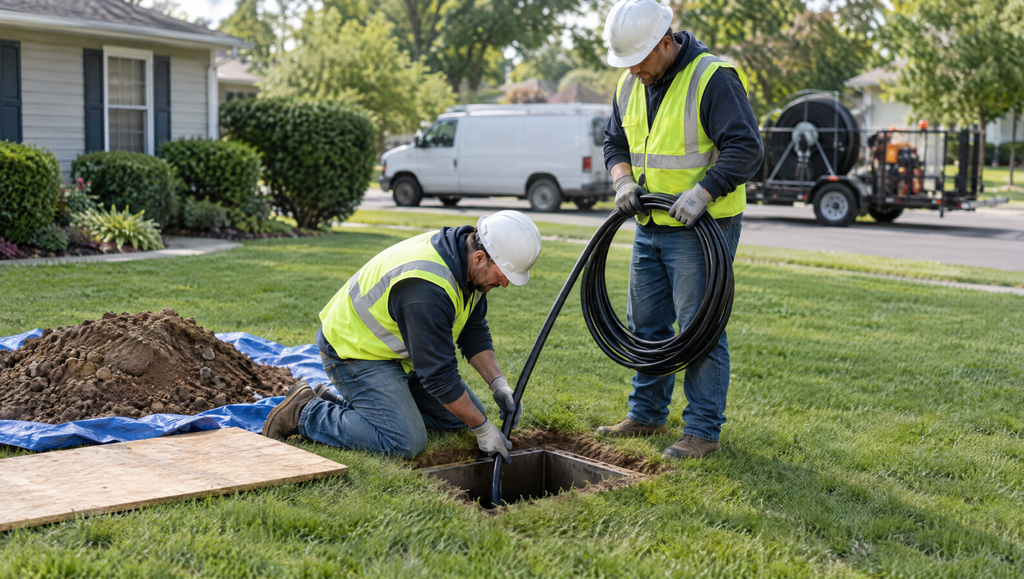
Trenchless sewer repair is a set of methods for repairing or replacing a sewer line from the inside, through one or two small access points, instead of excavating a trench along the pipe's full length. Crews work through an existing cleanout, the capped pipe stub near the house, or through a small pit dug at each end of the run. The two methods used on residential lines are cured-in-place pipe lining and pipe bursting.
The pipe in question is your sewer lateral: the single line that carries waste from every toilet, sink, shower, and appliance in the house out to the city main or a septic tank. It fails for predictable reasons. Tree roots work into joints looking for moisture, clay and cast iron crack and corrode, soil shifts and takes the pipe's slope with it, and older materials simply reach the end of their life.
Trenchless repair is not the answer to a one-off clog. If a single fixture backs up on its own, the problem is almost always a branch drain rather than the main line, and our drain repair guide walks through those symptoms. Trenchless work is for the buried line itself, once a camera has shown that the pipe, not the water in it, is the problem.
Sewer line failures rarely happen at a convenient hour, which is exactly when people hire the first number they find. Wise Workman gives you a scored shortlist of sewer repair companies near you now, so the decision is already made when you need one.
How Does CIPP Pipe Lining Work and How Long Does It Last?
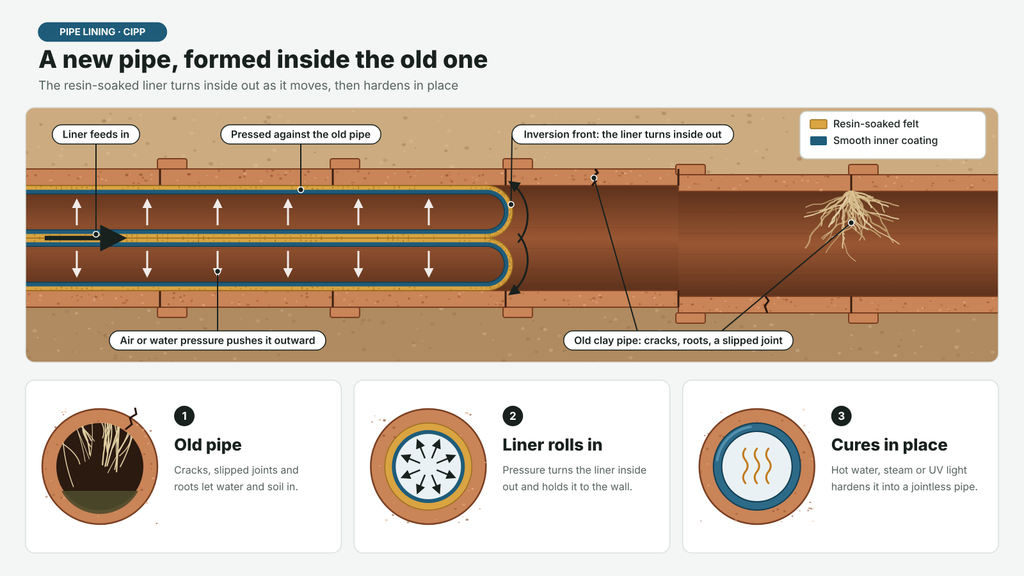
CIPP stands for cured-in-place pipe. The crew cleans the old pipe, pulls or inverts a resin-saturated felt tube into it, inflates the tube so it presses tight against the pipe wall, and cures the resin until it hardens. What you are left with is a smooth, jointless pipe formed inside the old one. CIPP liners are designed for a service life of about 50 years under ASTM F1216, the standard practice that governs inversion-and-cure rehabilitation.
The CIPP Process, Step by Step
- Camera inspection: A push camera or crawler records the full run, locates every crack, root intrusion, and offset joint, and measures diameter and length. Ask whether the technician codes defects to NASSCO PACP standards, which is the industry's shared language for pipe condition.
- Cleaning: A hydro jetter cuts out roots, grease, and scale so the liner has a clean wall to bond to. A liner installed over buildup will telegraph every lump underneath it.
- Installation: The resin-saturated tube is inverted or winched into the host pipe and inflated with air or water pressure.
- Curing: Ambient cure, hot water, steam, or UV light hardens the resin. UV is the fastest; steam and hot water are the common choices on residential laterals.
- Reinstating connections: A robotic cutter reopens any branch lines the liner sealed over. A missed reinstatement is one of the most common CIPP defects, and one of the easiest to spot on video.
- Final inspection: A second camera pass documents the finished liner end to end. Ask for both the before and after footage.
Where Lining Falls Short
A liner is only as straight and as round as the pipe it cures inside. It cannot lift a sagging section, bridge a collapse, or correct a slope that was wrong the day the line went in. It also gives up a small amount of inside diameter, although the smoother wall normally makes that back in flow.
What Certification Should the Installer Hold?
Liner manufacturers certify installers on their own specific product, and NASSCO's Inspector Training and Certification Program for CIPP trains crews and inspectors on what a correct installation looks like. Ask which liner system the company is certified to install, and ask to see the certificate rather than the logo on the van.
When Is Pipe Bursting the Right Call?
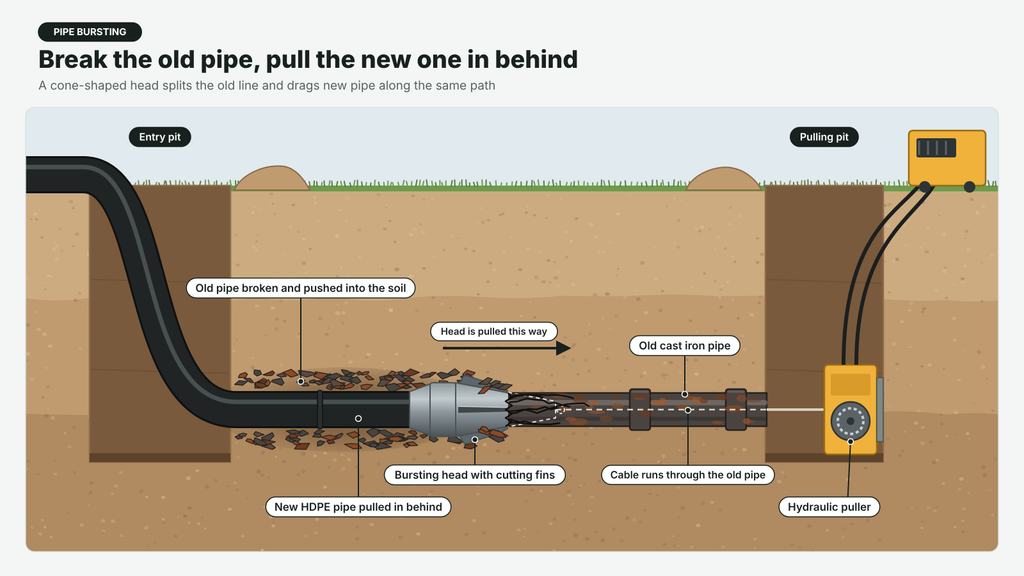
Pipe bursting is the right call when the old pipe is too far gone to line but still runs a reasonably straight path. A cone-shaped bursting head is winched through the line, fracturing the old pipe outward into the surrounding soil while a new pipe is pulled in directly behind it. You end up with a brand-new pipe rather than a liner inside an old one.
The replacement is normally HDPE, high-density polyethylene, joined by heat fusion to ASTM F2620 so the finished run has no joints for roots to find and nothing that can rust. Bursting fits best when:
- The old pipe is cracked in many places, crushed, or corroded past the point where a liner could bond to it.
- You need more capacity, since the new pipe can match or exceed the original diameter.
- The line is Orangeburg, the bituminous-fiber pipe installed from roughly the 1940s into the early 1970s, which deforms into an oval as it ages.
- The run is made of mixed materials, so a single liner would not sit evenly along its length.
What Pipe Bursting Needs From Your Yard
Bursting is not a no-dig method; it is a less-dig method. It needs a launch pit and a receiving pit, usually one near the house and one at the property line or the city connection. It also pushes soil outward as the head passes, so the crew has to know what else is buried close by. Utilities should be located through 811 before the job, and gas, water, or electrical lines running parallel and close to the sewer can rule the method out altogether. Tight bends are the other limit, because both the head and the new pipe need a path they can be pulled through.
Pipe Lining vs. Pipe Bursting vs. Digging: Side by Side
Here is how the three methods compare on the points homeowners actually have to weigh:
| Pipe lining (CIPP) | Pipe bursting | Digging (open-cut) | |
| Access needed | Often none, or one small access point | Two pits, one at each end | A trench along the whole run |
| Typical job time | Usually one day | One to two days | Several days, plus yard repair |
| Pipe size afterwards | Slightly narrower, but smoother | Same size or a little bigger | Any size local code allows |
| Expected service life | Designed to about 50 years under ASTM F1216 | Many decades, since fused HDPE cannot rust | Many decades, depending on the new pipe |
| Stops root intrusion | Yes, a cured liner has no joints | Yes, fused HDPE has no joints | Yes, with the new pipe |
| Corrects slope or a sag | No | No | Yes, and it is the only method that can |
| Works under a driveway or slab | Yes | Yes, if the pits can be placed | Only by breaking the surface |
| Best for | Cracked or root-infiltrated pipe that still holds its shape | Badly broken, undersized, or Orangeburg lines on a fairly straight path | Sags, collapses, a wrong slope, or a line that has to be rerouted |
| Main limitation | Cannot correct a sag or a caved-in section | Struggles with sharp bends and close utility lines | Tears up whatever sits on top of the pipe |
| Surface restoration | Minimal | Two small patches | Lawn, driveway, or sidewalk rebuilt |
Trenchless vs. Digging: Where the Money Actually Goes
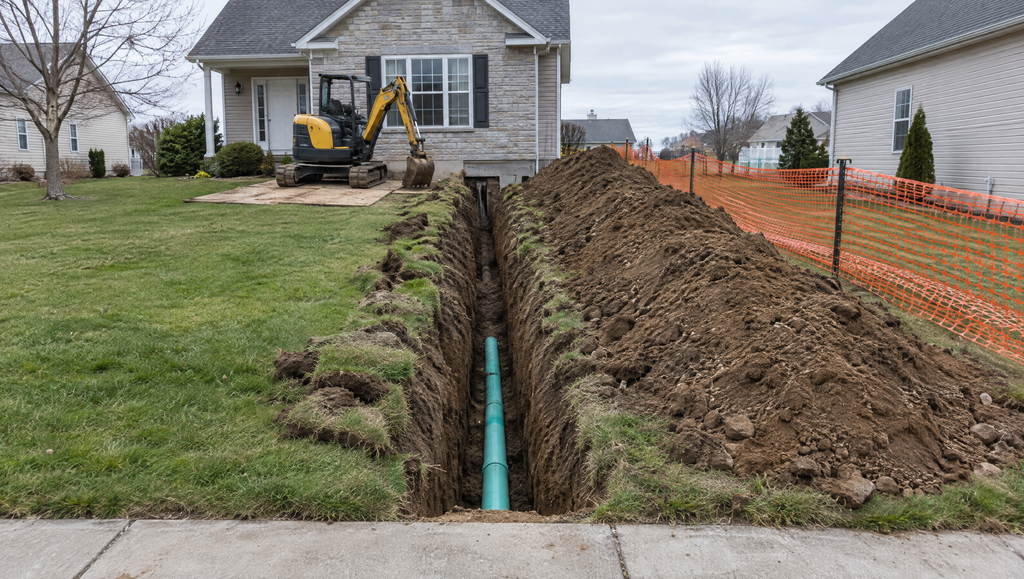
Per foot of pipe, trenchless work usually prices higher than open-cut. The reason homeowners often pay the same or less overall is that excavation pricing is only half the invoice. The other half is putting back the lawn, driveway, patio, sidewalk, or mature planting that sat on top of the line. The more valuable the surface above the pipe, the faster the trenchless premium pays for itself.
Two things flip the answer quickly. A line running under a driveway, a slab, or a row of established trees tilts strongly toward trenchless, because restoration is what dominates the bill. A short, shallow run across open lawn often favors digging, because there is little above it worth protecting. Depth and length push both methods up.
For current figures by method and pipe material, see our sewer repair cost estimates. This guide stays on the question of which method your pipe actually needs.
When Won't Trenchless Work on Your Sewer Line?
Trenchless repair will not work when the pipe has a sag, has fully collapsed, or has joints that have shifted badly out of line. Lining and bursting both follow the path of the existing pipe, so they reproduce its geometry, faults included. In those cases, a crew excavates the failed section and rebuilds it to the correct slope.
Watch for these findings in the camera report:
- A sag, or belly: a low spot where water stands. A liner cures to the same shape, so the slope has to be corrected by digging.
- A full collapse: a liner has nothing to cure against, and bursting cannot start if no cable can be pushed through.
- Badly shifted joints: when pipe sections slide far out of line, a liner cannot bridge the gap.
- Sharp bends or close utilities: bursting struggles around tight corners and pushes soil outward, which can damage pipes and cables running next to yours.
It helps to know what each finding points to before a contractor explains it:
| What the camera shows | What it usually means | Likely method |
| Standing water in one section | A sag or belly, so the slope is wrong | Dig that section |
| Pipe wall missing, soil visible | A collapse | Dig, or burst if a path can be made |
| Stepped edges where two pipes meet | An offset or shifted joint | Dig that joint |
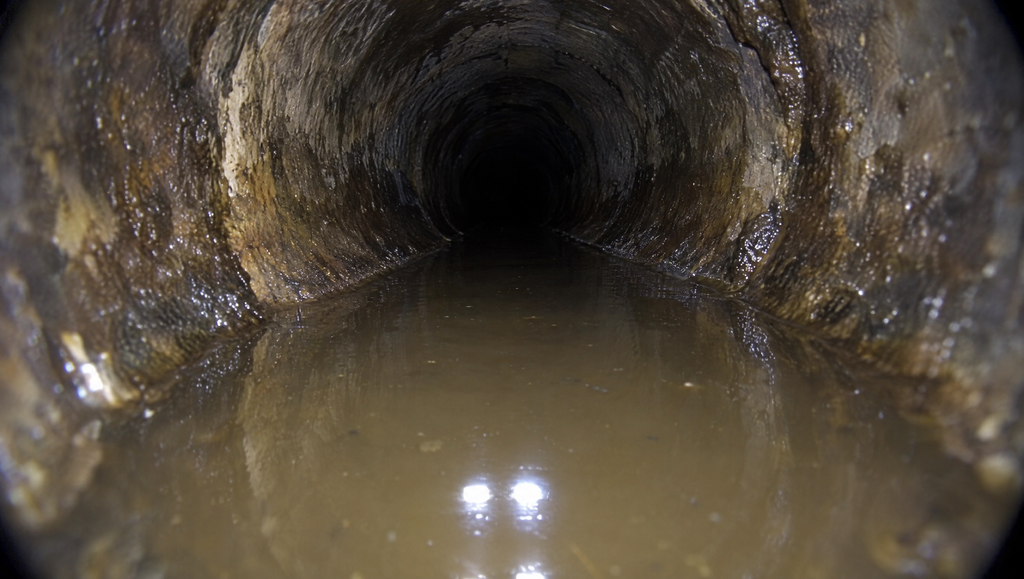
| Roots at several joints, wall intact | Root intrusion in a pipe that still holds its shape | Line it |
| Oval or deformed wall | Orangeburg, or a crushed pipe | Burst it |
| Cracks along a straight, round run | Structural cracking with the shape intact | Line it |
Many jobs mix methods: the crew digs out one bad section, then lines or bursts the rest. That is normal, and usually cheaper than excavating the whole run. If roots have been a recurring problem, it is worth knowing what routine sewer line cleaning involves once the repair is finished.
How Long Does Trenchless Repair Take?
Most residential lining jobs are finished in a single day, and the lining itself takes only a few hours. Pipe bursting usually runs one to two days. Open-cut takes the longest, often several days plus the time to rebuild whatever sat above the pipe. The permit is frequently the real schedule driver: many municipalities require one for lateral work, along with an inspection before pits or trenches are backfilled.
You can stay in the house while the crew works, but you cannot run water or flush a toilet while the line is open, because there is nowhere for it to go. A glue-like smell during curing is normal and clears quickly. If it is strong indoors, open a window and tell the crew, since it usually means a floor drain trap has dried out or a cleanout cap is off.
Ask for the sequence in writing before the crew arrives: camera, clean, install, cure, reinstate the branch connections, final camera, inspection, backfill. A company that cannot walk you through that order has not planned your job.
What Does a Trenchless Warranty Actually Cover?
Most trenchless jobs carry two separate warranties: a material warranty from the manufacturer of the liner or pipe, which covers defects in the product, and a workmanship warranty from the installing contractor, which covers how the job was done. Neither normally covers a new blockage caused by grease, wipes, or roots entering a section that was never repaired.
The two often run for different lengths of time, so read both and check:
- What is covered: just the repaired section, or the whole line out to the street.
- Who pays to reach a failed repair: some warranties replace the liner but not the excavation needed to get at it.
- Whether it transfers: a warranty that passes to the next owner is worth real money at closing.
- What voids it: some manufacturers exclude chemical drain cleaners or mechanical rodding once the liner is in.
- That it is in writing: a verbal promise is hard to enforce later, so file it with your camera footage.
How to Vet a Trenchless Contractor Before You Sign
A capable trenchless company does more than own the equipment. It starts with a camera inspection, shows you the footage, and explains why it chose lining, bursting, or digging for your particular pipe. It holds the license your state requires, carries general liability and workers' compensation insurance, pulls the permit itself, and books the inspection. Specialist equipment parked in the driveway is not the same thing as a crew certified to use it.
Questions to Ask a Trenchless Contractor
Bring these to every estimate. A company that does this work routinely answers them without hesitating:
- Can I see the camera footage, and can I keep a copy?
- Is the camera technician PACP-certified, and will I get a written condition report?
- Why this method for my pipe, and what would make you switch to digging?
- What happens to the price and the schedule if you find a collapse or a sag once you have started?
- Which liner or pipe system do you use, and are you certified by that manufacturer to install it?
- Who pulls the permit and books the city inspection?
- What do both warranties cover, and can I read them before I sign?
- Who restores the lawn, driveway, or sidewalk, and is that included in this quote?
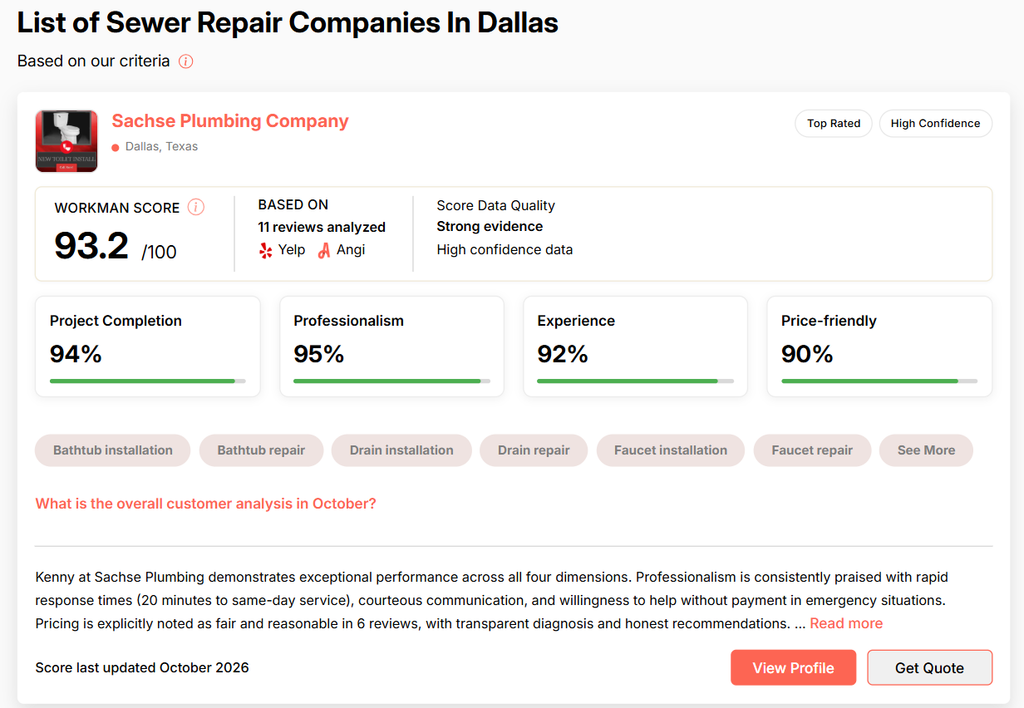
The fastest way to do that vetting is to start with a shortlist instead of a search page. Wise Workman is a plumber directory covering all 50 states, where every listing carries a WW Score built from license status, insurance, service history signals, and review authenticity, including checks that flag AI-generated and duplicated reviews. You get the same information a careful homeowner would spend an afternoon assembling, on one page, before you call anyone.
Your Checklist for Vetting a Trenchless Company
If you would rather run the checks yourself, work through this list before you sign anything:
- Verify the license on your state licensing board's website. A number printed on a truck does not prove the license is active, in good standing, or that it covers sewer work. You can also browse plumbers by state on Wise Workman and see license status next to each profile.
- Ask for a current certificate of insurance, including workers' compensation, which is what protects you if someone is injured on your property.
- Read reviews on more than one platform and look specifically for sewer line jobs, not drain cleaning. Four hundred reviews for faucet work tell you nothing about whether a crew can line a lateral.
- Get at least two written quotes that name the method, the length of pipe, the liner or pipe brand, who pulls the permit, and who restores the surface.
- Confirm the quote was written after a camera inspection of your line, not over the phone from your description of the symptoms.
Red Flags That Should End the Conversation
- A method recommended, or a price quoted, before anyone has put a camera down your line.
- Refusal to hand over the footage or a written condition report.
- Pressure to sign today, or a discount that expires this afternoon.
- "We don't need a permit here," with no reference to the local rule that says so.
- Cash only, or a large deposit before any equipment reaches your property.
Mistakes Homeowners Make Most Often
- Treating repeat backups as clogs. Rodding the same line three times in a year is a diagnosis, not a maintenance plan.
- Lining a short patch when the whole run is failing. Roots re-enter at the end of a partial liner, and you pay to mobilize a crew twice.
- Skipping the post-job camera pass. That final video is your proof the liner cured and every branch connection was reinstated.
- Letting the contractor keep the footage. You will want it for a warranty claim, an insurance question, or a buyer's inspector.
- Comparing quotes on the repair line alone. With open-cut, the restoration line is where bids really diverge.
Trenchless Sewer Repair FAQs
Does homeowners insurance cover sewer line repair?
Usually not when the damage comes from age, wear, or tree roots, because most standard policies exclude those causes. Some insurers sell a service line endorsement that does cover the buried lateral, so check your declarations page or call your agent before work starts rather than after.
Can tree roots grow through a pipe liner?
A cured liner has no joints, so roots have no easy way in. They can still find a path where a short liner ends, or through a branch line that was never lined, which is why lining the full run usually outlasts a spot repair.
How do I know my sewer line needs repair?
Watch for several drains running slow at the same time, gurgling toilets, a sewer smell outdoors, or a patch of lawn that stays soggy in dry weather. Those point at the main line rather than one fixture; our drain repair guide covers how to tell a branch drain problem from a failing lateral.
Do I need a permit for trenchless sewer repair?
In most municipalities, yes. Work on the sewer lateral is permitted work, and many jurisdictions require an inspection before pits or trenches are backfilled. The contractor should pull the permit and book the inspection; if they ask you to do it, treat that as a warning sign.
How soon can I use water again after a liner is installed?
Normally the same day. Once the resin has cured and the robotic cutter has reopened the branch connections, the line is back in service. The crew should tell you exactly when, and the final camera pass should happen before they leave your property.
Does a liner make the pipe too narrow?
A liner takes a small amount of inside diameter, but it replaces a rough, root-scarred wall with a smooth one, so flow is typically unchanged or slightly better. Where diameter really is the problem, because the original line was undersized, bursting is the better answer, since it can upsize.
Can trenchless repair be done under a driveway or a slab?
Yes, and that is where it earns its premium. Lining and bursting both work from access points at either end, so concrete, pavers, and mature trees above the line stay where they are.
What is the difference between a spot repair and a full-length liner?
A spot repair, sometimes called a sectional liner, cures a short sleeve over a single defect. A full-length liner treats the whole run from the house to the connection. Spot repairs suit one isolated crack in an otherwise sound pipe, and are a poor choice when the camera shows damage in several places.
Will pipe bursting damage nearby pipes or cables?
It can, because the bursting head pushes fragments of the old pipe outward into the soil. A competent crew has utilities located through 811 first, and will rule the method out where gas, water, or electrical lines sit close and parallel to the sewer.
How We Put This Guide Together
This guide is written and maintained by the Wise Workman editorial team, which covers residential plumbing for homeowners in all 50 states. The method descriptions follow the published standards each technique is actually built on: ASTM F1216 for cured-in-place pipe installed by inversion and curing, and ASTM F2620 for the heat-fused joints used in HDPE pipe bursting. The inspection guidance follows NASSCO's PACP condition coding and its ITCP training program for CIPP, which is the framework municipal inspectors and specialist contractors work to.
The vetting advice mirrors what Wise Workman checks when it scores a plumbing company: license status, insurance, service history signals, and review authenticity, including checks that flag AI-generated and duplicated reviews. You can read the full methodology in how the WW Score works, and how the underlying data is handled in our data governance policy.
Pricing is deliberately kept out of this guide so the figures live in one place and stay current. For current ranges by method and pipe material, see our sewer repair cost estimates