Your toilet gurgles every time the washing machine drains, and you tell yourself it is nothing. Two weeks later, dirty water is pooling around the basement floor drain.
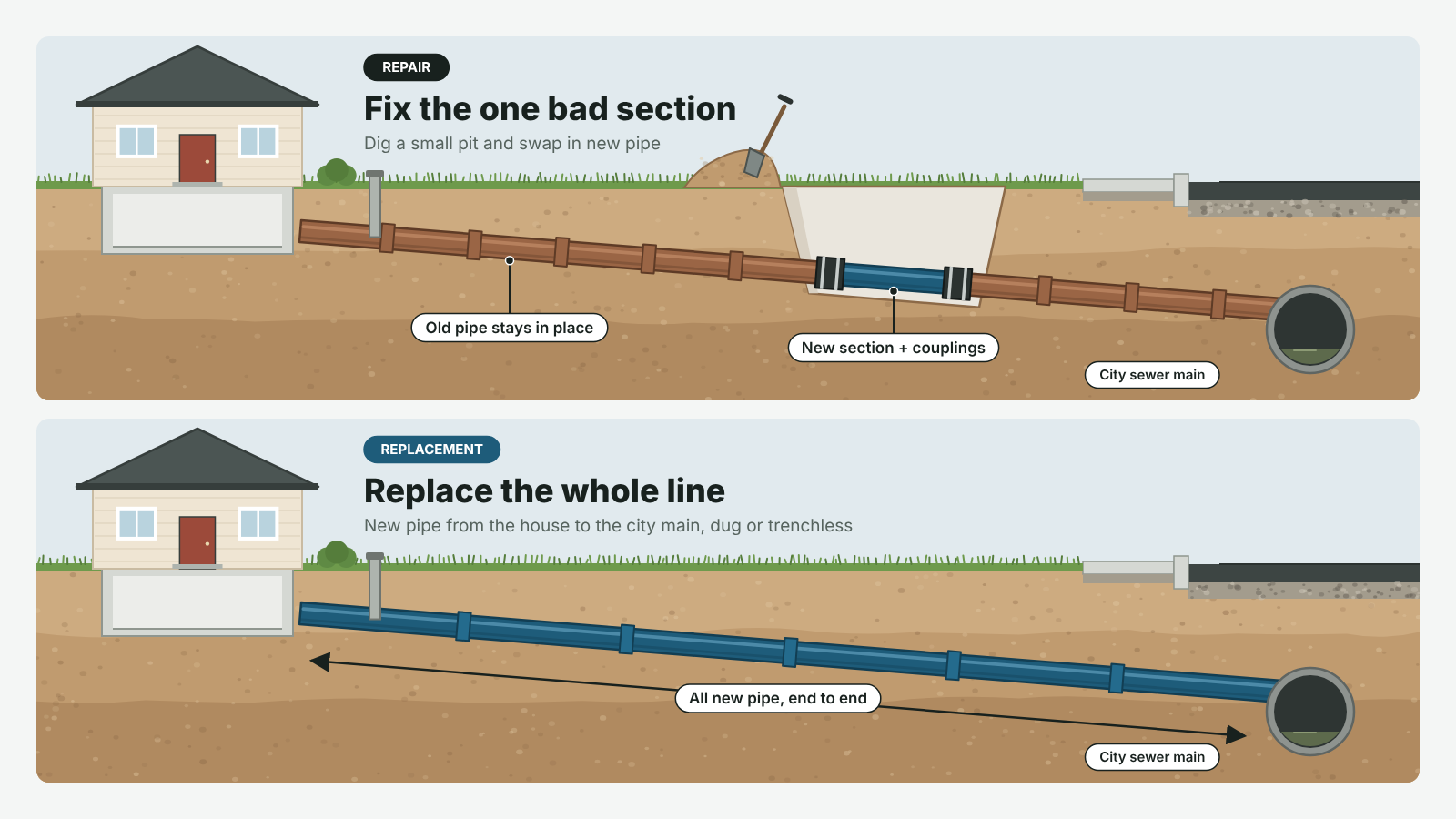
Choosing between sewer line replacement vs. repair comes down to how much of the pipe is damaged. If a camera finds one crack or one root spot, a repair is usually enough. If the pipe is old, broken in many places, sagging, or made of Orangeburg (a pipe made of paper and tar), replacing the whole line makes more sense. In most cities, you own the pipe from your house to the city main, which is why the bill lands on the homeowner, not the utility.
Key Takeaways
- A sewer camera inspection decides repair vs. replacement, so do not agree to either one until you see the video.
- Repair fits one bad spot in a healthy pipe, while replacement fits old pipe with many problems, a sag, or Orangeburg.
- Trenchless methods save your yard, but a liner cannot fix a pipe that sags or has caved in.
- You usually own the pipe up to the city main or the property line, depending on your city's rules.
- Standard homeowners insurance rarely pays for a worn-out sewer line, but service line coverage often does.
What Are the Signs Your Sewer Line Is Failing?
The main signs of a failing sewer line are slow drains all over the house, gurgling toilets, sewage smells, and backups in the lowest drain, like a basement floor drain or shower. A soggy, extra-green patch of lawn or a dip in the yard above the pipe can also mean the line is leaking underground.
One slow sink is usually a simple clog that our drain repair guide can help with. When many drains act up at once, the problem is the main sewer line, because every drain in the house empties into that one pipe. Watch for these warning signs:
- Slow drains in more than one room at once
- Gurgling from a toilet when another drain runs
- Water coming up the shower or floor drain when you flush
- A wet, extra-green, or sinking strip of yard
- Clogs that keep coming back after a cleaning
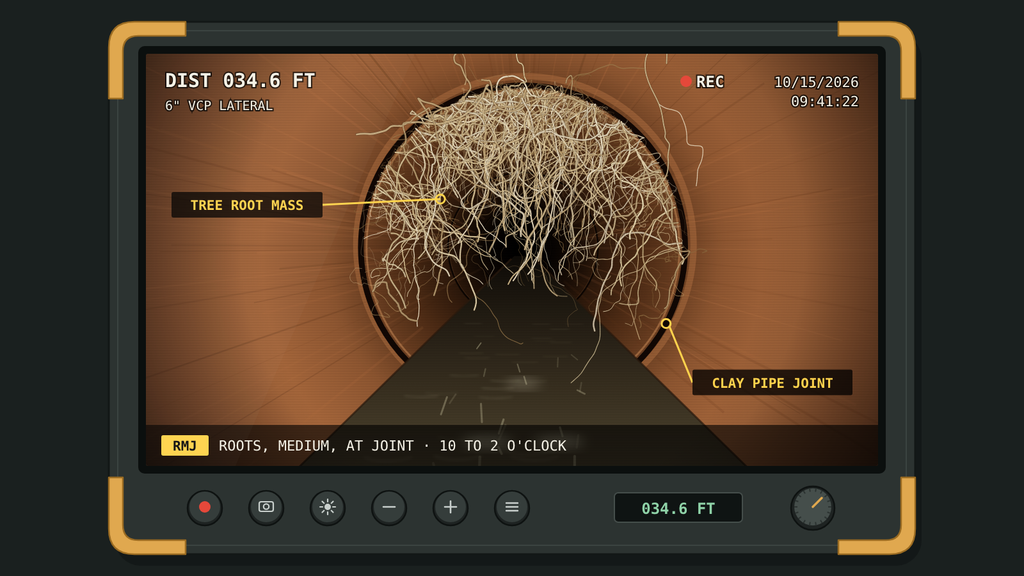
If you see two or more, ask for a sewer camera inspection: a small camera on a long cable rides through the pipe and shows exactly where the damage is. Ask the plumber to narrate the footage and mark each defect by its distance from the house, so you can tell one bad joint from a line that has failed end to end.
What Should You Do Right Now If Sewage Is Backing Up?
Stop sending water down the drains. Every flush, shower, and wash cycle adds to what is already backing up, and the lowest drain in the house is where it comes out, so shut off the washing machine and dishwasher mid-cycle if they are running.
Keep people and pets away from standing sewage, and do not pour drain chemicals into a line that is already blocked, because the liquid sits in the pipe and splashes back on whoever opens it. If sewage is coming up through a floor drain or a tub, call for same-day help instead of waiting for a scheduled visit, and ask for a camera scope once the line is clear. Take photos before anything gets cleaned up, because you will need them if the break turns out to be on the city’s side or if you file an insurance claim.
Sewer line failures seldom happen at a convenient hour, which is exactly when people hire the first number they find. Wise Workman gives you a scored shortlist of sewer line companies near you now, so the decision is already made when you need one.
Cast Iron, Clay and Orangeburg: Why Do Old Sewer Lines Fail?
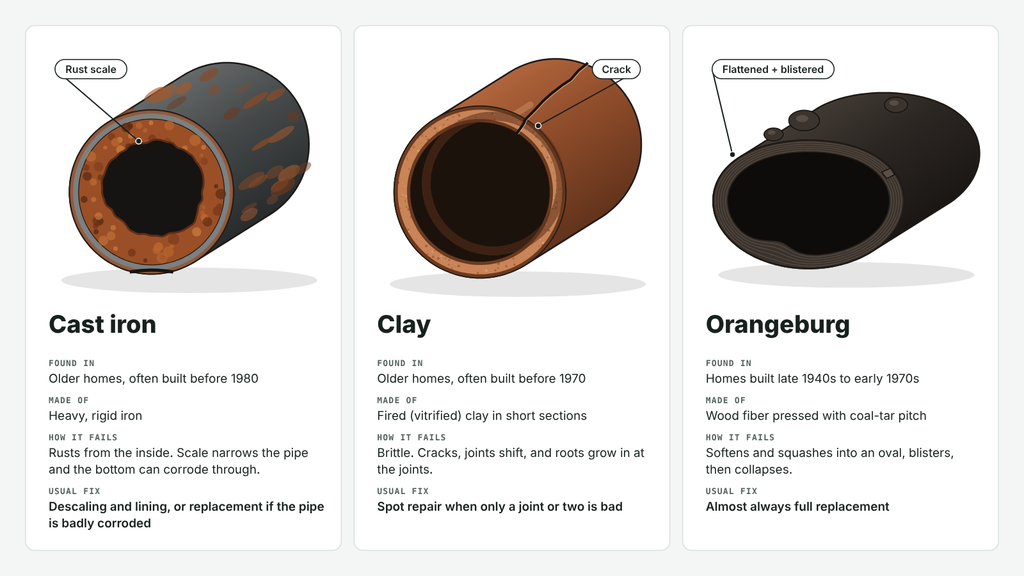
Old sewer lines fail because of what they are made of. Cast iron rusts from the inside, clay has weak joints that let tree roots in, and Orangeburg is pressed paper and tar that goes soft and flattens. Most homes built before the 1980s have at least one of these three.
| Pipe Material | Usually Found In | How Long It Lasts |
| Cast iron | Homes built before the 1980s | About 50 to 75 years |
| Clay | Older homes, often out in the yard | About 50 to 60 years before the joints give trouble |
| Orangeburg | Homes built from the 1940s to the early 1970s | Sold to last 50 years, but many fail far sooner |
| PVC (plastic) | Newer homes and past repairs | 100 years or more |
Cast Iron Sewer Pipe
Water and waste make cast iron rust from the inside, so the walls get thin and rough, and paper and grease snag on the bumps.
Clay Sewer Pipe
The clay itself is tough, but the joints where short pieces meet have tiny gaps, and tree roots grow into them looking for water.
Orangeburg Sewer Pipe
Orangeburg soaks up water over time, so it goes soft and squashes from a circle into an oval until waste can barely get through.
How Do You Tell If You Have Orangeburg Pipe?
Start with the build date, because Orangeburg went into American homes mostly between 1945 and 1972, so a house from that window with its original lateral is the main candidate. On camera, it shows up as a pipe that has gone oval instead of round, with a soft, fibrous wall rather than the hard shell of clay or cast iron. Your city’s sewer permit card or tap record often lists the lateral material, and the public works department can usually look it up by address. If a camera finds Orangeburg, treat replacement as the default, because lining a pipe that has already lost its shape does not bring the shape back.
Sewer Line Replacement vs. Repair: Which One Do You Need?
Choose a repair when a camera shows one or two problem spots in a pipe that is otherwise solid. Choose replacement when the pipe is old and damaged in many places, sags so water sits in it, has caved in, or is Orangeburg. Patching a worn-out pipe again and again usually costs more over time.
A sag, which plumbers call a belly, is a low spot where waste settles instead of flowing out. Here is how the two choices compare:
| Factor | Spot Repair | Full Replacement |
| Best for | One crack, root spot, or broken joint | Many cracks, a sag, a collapse, or Orangeburg |
| Rest of the pipe | In good shape, with years left | Old and near the end of its life |
| Digging | One small hole, or none with a liner patch | A trench, or two small holes with trenchless |
| What happens next | Other old sections may still fail later | A new pipe that lasts for decades |
Here is a simple test: ask how much of the pipe is still good. If the answer is "most of it," repair the bad spot, but if it is "not much," replace the line, because every patch on an old pipe is a bet that the next section holds.
What Changes the Size of a Sewer Line Job?
Three things decide how big a sewer line job gets: what the pipe is made of, how deep and long it runs, and what sits on top of it, like trees or a driveway. City permits add steps too, especially when the damage is under the road.
How Pipe Material Changes the Scope of Work
The pipe material often decides the fix:
- PVC with one break: a quick spot repair.
- Clay with roots at a few joints: cut the roots out, then patch the joints or line the pipe.
- Cast iron with rust buildup: scrape it clean (called descaling), then line it if the walls are still thick.
- Orangeburg: almost always full replacement, because it is usually too squashed to line.
Many old lines are a mix, like cast iron under the house and clay in the yard, so one pipe can need two fixes.
How Depth, Length and Landscaping Change the Job
Depth matters because deep trenches can cave in, so OSHA rules require cave-in protection, like a steel trench box, in any trench 5 feet deep or more unless it is cut entirely in stable rock, and a shallower trench still needs protection if the competent person on site judges it unsafe. A long run means more pipe and more digging, which is where trenchless shines. Trees, a driveway, or a patio all have to come up for a dig, so ask whether the quote includes putting your yard back.
Permits, Street Cuts and Municipal Fees
Most cities require a permit and an inspection, and a licensed plumber usually pulls the permit for you. Damage under the street also needs a street cut permit, traffic safety setup, and a road patch that meets city rules, which adds days and city fees. Before digging, the contractor must call 811, the free call-before-you-dig line, because having buried gas, power, and water lines marked first is required by law in nearly every state.
Trenchless vs. Traditional Dig: How Do You Choose?
Pick trenchless when the pipe still holds its shape and runs under things you want to keep, like a driveway or big trees. Pick a traditional dig when the pipe sags, slopes the wrong way, has caved in, or is short and shallow. Ask for camera footage that backs up the choice.
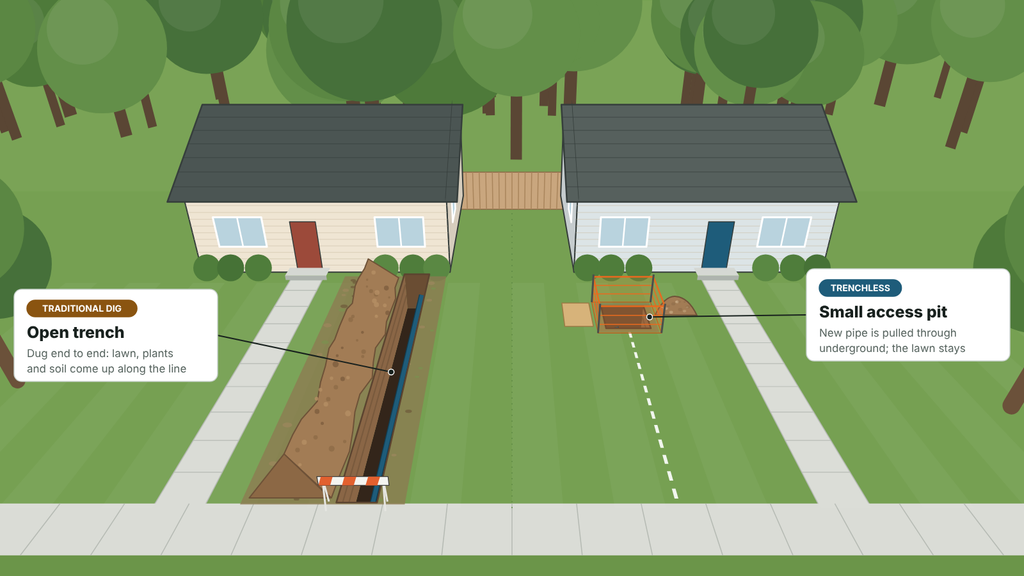
Trenchless means fixing the pipe through one or two small holes instead of a long trench, and it comes in two kinds:
- Pipe lining (CIPP): a resin-soaked tube is pulled into the old pipe and hardened, making a new pipe inside it.
- Pipe bursting: a cone-shaped head breaks the old pipe apart while pulling a new one in behind it.
| Method | Best For | Not a Fit For |
| Pipe lining | Cracks, roots, and rust in pipe that still holds its shape | Sags or caved-in pipe |
| Pipe bursting | Full replacement under driveways or big trees | Sags, or pipe close to other buried lines |
| Traditional dig | Sags, wrong slope, collapse, or short shallow runs | Lines under a driveway or trees you want to keep |
Trenchless usually costs more per foot, but it leaves the driveway and lawn alone, so it often evens out once you count putting the yard back.
How Much Does Sewer Line Repair or Replacement Cost?
A spot repair on a short, shallow pipe sits at the low end, while full replacement of a long, deep line under a driveway or street sits at the high end. Pipe material, trenchless or dig, permits, and putting the yard back all move the number. As a rough frame, a spot repair on a damaged 5- to 10-foot section usually runs $1,500 to $4,000, trenchless lining of a full line runs $4,000 to $10,000, and a traditional dig with full replacement runs $5,000 to $15,000 or more, which works out to roughly $50 to $250 per foot for open trench and $60 to $300 per foot for trenchless. Check our sewer repair cost estimate for current local prices.
Who Owns the Sewer Line: Homeowner or City?
In most places, the homeowner owns the sewer line from the house to the city's main sewer pipe or to the property line, and the city owns the main. Where your part ends depends on local rules, so call your city's public works or sewer department before any work starts.
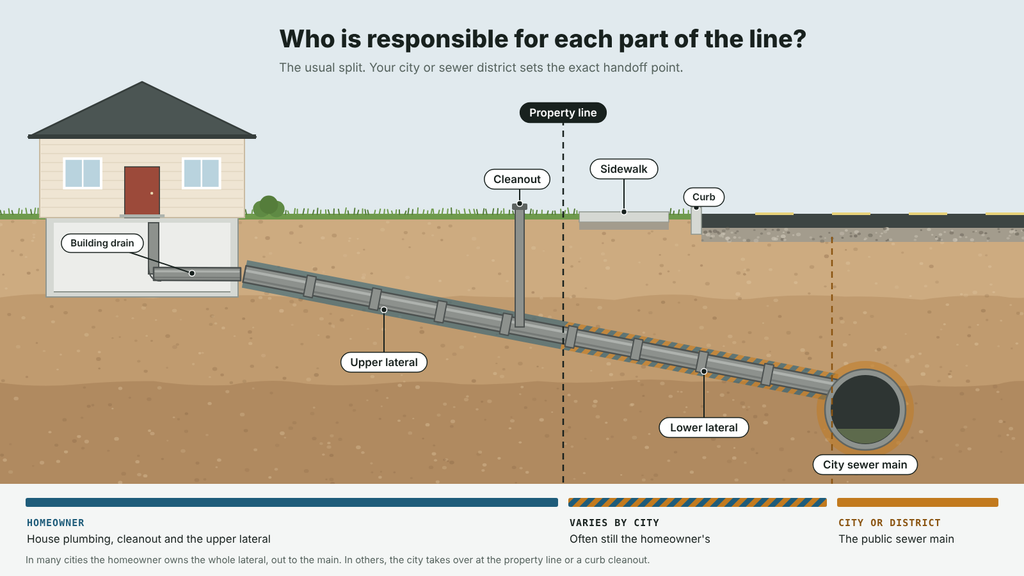
Your section of pipe is called the lateral, and cities split it in one of three ways:
- To the property line: you own only the pipe in your yard.
- To the main: you own it even under the sidewalk and street, which surprises a lot of people.
- To the cleanout: some cities stop at the cleanout, the capped pipe near the curb used to clear clogs.
If the camera shows the break is on the city's side, report it right away and keep the video as proof.
To find out which rule applies to you, call the city’s public works or sewer department and ask where the city’s responsibility begins on your street. Many cities keep a sewer card or tap record for every address that shows where the lateral meets the main, and some will email you a copy the same day. Older neighborhoods sometimes have a shared lateral, where two or three houses feed one pipe before it reaches the main, and the cost is usually split between those owners, so ask whether yours is shared before you agree to pay for the whole job.
If the break is on the city’s side, most cities repair it at no cost to you, but they generally want the report in writing and will run their own camera first, which takes a few days. Do not let a contractor open the street on your dime before the city has looked at it, because that money does not come back.
Once you know the pipe is yours, the next question is who you let near it. Wise Workman lists sewer contractors in your area with the license and insurance check already done, so your first call goes to someone whose paperwork has been read rather than whoever ranked highest that morning.
Does Homeowners Insurance Cover Sewer Line Replacement?
Usually not, because standard homeowners insurance treats old age, rust, and tree roots as normal wear and tear. Many insurers sell an add-on called service line coverage that does pay to fix broken buried pipes, and some cities team up with warranty companies that cover the lateral.
Two add-ons sound alike but do different jobs:
- Service line coverage pays to dig up and fix the broken pipe itself.
- Sewer backup coverage pays to clean up your home after sewage backs up inside, but it does not fix the pipe.
Ask your agent whether you have service line coverage, what the limit is, and whether it reaches the city main or stops at the property line.
Service line coverage is cheap for what it does, commonly around $30 to $150 a year for $10,000 to $20,000 in limits, but it has to be on the policy before the pipe fails, so add it at renewal rather than after a backup. If you do file a claim, the adjuster will ask for the camera video, the plumber’s written scope, and dated photos of the dig, so collect them while the work is happening instead of afterward.
How Do You Vet a Sewer Contractor and Avoid Upsells?
Vet a sewer contractor by checking the license and insurance, asking for the camera video and a written scope, and getting a second camera opinion before any full replacement. Upsells usually show up as pressure to decide today, a replacement pushed without footage, or a quote that leaves out permits and yard repair.
A good sewer company shows you the problem before it sells you the fix:
- It shares the full camera video, with problem spots marked by distance from the house.
- It explains both repair and replacement and why one fits your pipe better.
- Its written quote lists the method, the new pipe, permits, and yard repair.
Be wary of a free inspection that ends in a replacement quote with no video, a liner pitched for a sagging pipe (a liner follows the sag, so it cannot fix it), or a request for most of the money up front.
The fastest way to do that vetting is to start with a shortlist instead of a search page. Wise Workman is a plumber directory covering all 50 states, where every listing carries a WW Score built from a license and insurance check plus the full review history across Yelp, Angi, Thumbtack, HomeAdvisor and Google, with authenticity checks that flag AI-generated and duplicated reviews. You get the same information a careful homeowner would spend an afternoon assembling, on one page, before you call anyone.
What Does a Scored Listing Show You?
Every profile opens with the same block, so two companies can be compared without reading two sets of reviews. The score sits out of 100, and beside it is the part that matters more: how many reviews it was built from, and which platforms they came from. The listing below rests on 210 reviews pulled from Yelp, Angi, Thumbtack, HomeAdvisor and Google, which is what earns it a strong evidence rating. A score built on a dozen reviews from a single site is not the same claim, and the count is printed right there so you can tell the difference. Underneath, the score breaks into project completion, professionalism, experience and price, so a contractor who finishes clean but quotes high is easy to spot before you pick up the phone.

If you would rather check a sewer contractor yourself, use this list:
- Look up the license on your state's licensing board website.
- Ask for proof of liability insurance and workers' comp.
- Read reviews that mention sewer line jobs, not just drain cleaning.
- Get the warranty in writing, for both the work and the pipe.
Sewer Line Repair and Replacement FAQs
Can tree roots be removed without replacing the pipe?
Yes, but only for a while. A sewer contractor can cut roots out with a spinning blade or a strong water jet (called hydro jetting), but roots grow back through the same gaps, so a liner or spot repair is needed to seal them.
How long does sewer line replacement take?
A trenchless replacement often takes one or two days. A traditional dig usually takes several days, because the trench has to be dug, inspected, and filled, and the yard put back, and work under a street adds city inspections on top of that.
Can I stay in my home during sewer line work?
Yes, most people stay home, but you cannot send water down any drain while the sewer line is open. Plan to skip showers, laundry, and flushing during work hours, and ask the crew each morning when the line will be usable again.
Should I get a sewer camera inspection before buying a home?
Yes, especially if the home was built before the 1980s or has big trees near the sewer line. The inspection is quick, and it can spot an Orangeburg pipe, roots, or a sag before you own the problem, so you can ask the seller to fix it.
What happens if the broken section is on the city’s side?
Report it to the city’s sewer or public works department in writing and send the camera video with it. Most cities repair their own side at no charge, but they usually schedule their own inspection first, so expect a short wait. Keep a copy of the report and the date you sent it, because that record is what settles any argument about who pays.
Does a home warranty cover sewer line replacement?
Sometimes, but the limits are low. Home warranty plans that include an outside sewer line option often cap the payout well below the cost of a full replacement and exclude damage that was already there when you bought the plan, so read the cap and the exclusions before counting on it. Service line coverage added to your homeowners policy generally pays more.